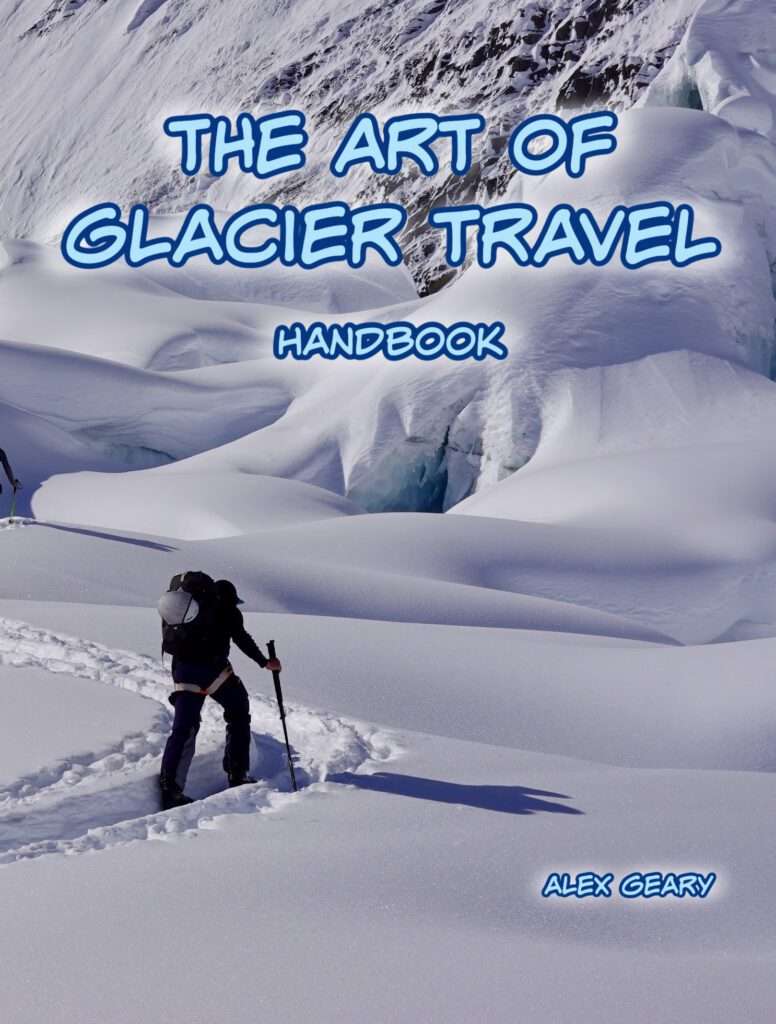
30 questions from The Art of Glacier Travel Handbook
Tap an answer to see the explanation.
Serac collapse frequency is linked most closely to what?
The sun doesn’t penetrate far into the ice, so time of day has little to do with it. Seracs collapse mainly because the glacier is moving, so they’re unstable at any hour. You can’t tell when one will fall: give them a wide berth, minimize time underneath, and look for cracks and recent debris.
Chapter 10: Seracs
Along its length, where does a glacier usually flow fastest?
Surface velocities tend to be faster near the firn line than at the terminus or summit. They’re also highest along the midline compared with the edges.
Chapter 3: Speed of Glaciers
Where on a glacier should you expect the most crevasses?
Crevasses form where the ice is under tension, most often at convexities. Where the flow slows down on benches, compression closes crevasses up. It’s usually safer to travel in compression zones, even when you can’t see any crevasses.
Chapter 5: Crevasses
How steep can glacial moraines be?
(The angle of repose is the steepest angle that loose material, like a pile of rocks or sand, can rest at without sliding.)
Clay in glacial till adds cohesion, so moraines can hold together at angles often over 40°. That’s prime slab avalanche terrain, and combined with the shallow snowpack often found on moraines, it makes them one of the most dangerous places to ski. Once rocks and dirt are exposed in spring, the avalanche hazard usually drops, but the rockfall hazard can be extreme.
Chapter 4: Glacier Anatomy
You’ve probed over 320 cm of snow in several places. Does that mean it’s safe to ski around unroped?
Probing tells you how much snow there is where you’re standing. You could probe hundreds of times, consistently get over 320 cm, and still fall through a weak bridge on your next step. A bridge over 20 m wide and cracked with wet snow might collapse under your weight even with that depth. Snow is often deeper in wind loaded compression zones and shallower on the convexities at the top of an icefall, where crevasses are biggest.
Chapter 17: Probing
When roping up for glacier travel, why shouldn’t you pre-rig a toothed device like a Nano Traxion or Tibloc on the rope?
Toothed devices break ropes at around 4 kN of force. They’re much faster than prusiks for climbing out of a crevasse, which is why pre-rigging prusiks for climbing no longer makes much sense, but you don’t want a toothed device on the rope when the fall happens.
Chapter 14: How to Rope Up
Skiing down a glacier, you see a horizon line ahead of you. What should that tell you?
Convexities are tension zones, and wind accelerating over them leaves a shallower snowpack. Even in areas without much wind, it’s normal to have at least 25% less snow on convexities. Check the map before skiing over a blind roll.
Chapter 12: Route Finding on Glaciers
How deep are crevasses typically?
Crevasse depth is limited by pressure in the ice, which increases with depth. They can be deeper with running water inside, or in cold, brittle glaciers. They often narrow as they get deeper, so an unroped fall is unlikely to be survivable unless a collapsed bridge partway down stops you.
Chapter 5: Crevasses
Skiing down a glacier unroped, where should you regroup?
Avalanche courses teach you to regroup on high points, but on a glacier those are usually tension zones with a thin snowpack. Flat areas can also be in tension zones with a lot of crevasses. Probing an area effectively to regroup while skiing downhill is usually impractical, and it puts the person probing at risk of falling in. It’s generally safer to find a compression zone, where crevasses are less likely.
Chapter 18: Regrouping
When do crevasses usually have the strongest bridging?
Late winter and early spring usually bring the deepest, most consolidated snowpack. Bridges are weakest in late fall or early winter, when the first snow hides crevasses under weak bridges.
Chapter 7: Evolution of Crevasse Bridges
Someone falls in and the rope cuts deep into the lip. What’s the risk of hauling them out on that same strand?
Hauling on the strand that has cut into the overhanging lip can cause serious injury or death. It’s better to have enough spare rope to reach the person, prepare the lip so the rescue rope doesn’t cut in, then haul them out.
Chapter 14: How to Rope Up
Crossing a rocky ablation zone, which rock is usually least stable underfoot?
Granite breaks into rounder boulders that move when you walk on them. Limestone is a sedimentary rock, so the broken pieces tend to be plate-shaped and interlock well, which makes them more stable.
Chapter 4: Glacier Anatomy
How should you determine where the crevasses are?
Looking at the map and observing the size, shape, snow conditions, wind effect and sags on a glacier matters more than probing. Probing gives you a number, so it’s tempting to weigh it too heavily. If you feel uncertain enough that you need to probe, you’re probably not in a safe enough place. Existing tracks aren’t proof either: walk up a popular ski route in late summer and you can see crevasses people have been skiing over all season.
Chapters 17 and 18
Why are bergschrunds usually harder to cross going up than coming down?
Snow and ice above the bergschrund keeps accumulating without moving, while the glacier below flows away and needs replenishing. That creates a step that’s hard to climb up and easier to get down.
Chapter 6: Bergschrund or Rimaye
You’re transitioning at the top of an icefall, where crevasses could be hidden. How should you handle your skis?
Skis spread your weight over a larger area, so you’re much less likely to break through a bridge than standing in boots. Keep one ski attached while you transition, and do it away from the main flow of the icefall, where the biggest crevasses are.
Chapters 7, 9 and 13
Ideally, how many people should be on a rope team?
With three, two people can arrest one person’s fall. Then one holds the weight while the other builds an anchor and starts the rescue. Travelling as a party of two is an advanced technique, where careful route finding is the main defence.
Chapter 14: How to Rope Up
You’re skiing down a glacier. Which line usually avoids the worst crevasses?
The glacier flows fastest along its midline, and convex rolls there are tension zones with the most crevasses. Gullies and planar slopes usually have fewer crevasses and deeper snow, as gullies get compression from the sides and extra wind-deposited snow. Check the map before choosing a side.
Chapters 3, 5 and 12
Roughly how much weaker is a wet, waterlogged rope?
Waterlogged ropes are roughly 30% weaker. They’re also heavy, knots are hard to untie, and they can freeze. A dry treated rope takes longer to become waterlogged.
Chapter 14: How to Rope Up
You need to get off the glacier, and the easiest-looking way down is a steep moraine with glacier ice underneath the rocks. What’s the main concern?
Many moraines beside retreating glaciers still have glacier ice underneath a thin layer of rock. As the ice melts and moves, the rock on top keeps shifting, sliding and falling, so steep ice-cored moraines can be extremely unstable. Signs include exposed dirty ice, fresh slumps, and rocks moving or falling. Avoid them where you can.
Chapters 4 and 20
What determines the strength of a crevasse bridge?
Depth and quality both matter. More snow generally means safer travel, but even 200 cm of fluffy powder won’t support your weight. Frozen bridges are stronger than wet ones, so a bridge that holds you in the morning may not in the afternoon.
Chapters 7 and 11
In a couloir, where is the best bridge over the bergschrund usually found?
The centre of a couloir is regularly filled in with avalanche debris. The edges aren’t filled in as often, so the bergschrund tends to stay open there. Don’t blindly follow the bootpack: it shows where others crossed, not that it’s the best bridge.
Chapter 15: Crossing Bergschrunds
For a group of skilled skiers, is skiing downhill roped always safer than skiing unroped?
Managing slack while skiing downhill is very difficult. Poor timing can pull a skier over onto a weak bridge or into a crevasse, or stop them in the middle of a sag without the momentum to carry them across. Arresting a fall is also hard, because you first have to arrest your own fall when you’re pulled over.
Chapter 13: When and Where to Rope Up
You see dirty stains and rocks on the snow or ice on the glacier below a large face with snow, rock and ice. What do they mean?
Dirty stains mean there has been recent rockfall. Risk of natural rockfall is low when everything is frozen, and it’s safer to travel earlier in the season while the slopes are still snow covered.
Chapter 20: Rockfall
When you can, which direction should you try to travel relative to crevasses?
Perpendicular is safest, which usually means straight up or down the fall line. It minimizes how far you pendulum if you fall in roped, keeps your rope mates further from the crevasse, and with skis on, makes you less likely to break through.
Chapter 12: Route Finding on Glaciers
When climbing up over a bergschrund, why doesn’t the leader usually need a belay?
If the leader falls in, the team below counterbalances them, so a belay usually isn’t needed. Once the leader is above the bergschrund, a fall by anyone below would likely pull them off their feet on the steep slope above, so the leader usually builds an anchor and belays the others across. It’s not a fixed rule. Belay the leader too if the bergschrund is big and steep enough that they’re placing protection and need an attentive belay, or if the rest of the rope team could fall and pull the leader off.
Chapter 15: Crossing Bergschrunds
Compared with a dynamic rope, how well does a low-stretch rope hold a crevasse fall?
Studies have shown people hold crevasse falls about as well with low-stretch rope. The fall factor is small, and the rope cutting into the lip and the team being pulled both absorb energy. Because low-stretch ropes don’t stretch, they limit the length of a crevasse fall and give a better energy transfer when hauling. They’re usually skinny though, which makes them hard to work with in a rescue, and they cut further into the lip of a crevasse.
Chapter 14: How to Rope Up
You need to traverse across the glacier above an icefall. Where should you cross?
The biggest crevasses are usually at the top of an icefall, and they often start well back from the convexity, even where it’s still flat. If you need to traverse, do it well above or below the convexity. Traversing also puts you parallel to most crevasses, so a whole rope team can end up on the same bridge.
Chapters 9, 12 and 13
How fast do glaciers in Canada and Europe typically flow?
Typically 50 to 200 m per year, but it varies a lot from glacier to glacier with climate, size, terrain, snowfall and ice temperature. Most glaciers also speed up during the summer melt season. They can look stationary when you stare at them, but they’re always moving.
Chapter 3: Speed of Glaciers
Which rope is not recommended for glacier travel on its own?
Twin ropes are tested as a pair. Used alone, they stretch more and are less resistant to sharp edges such as skis, crampons and toothed rope-grabbing devices.
Chapter 14: How to Rope Up
Where do stopper knots in the rope actually grab when someone falls in a crevasse?
Knots like the Overhand and a Half dig into consolidated snow at the lip, not ice, and work less well on skinnier ropes. ENSA found the best spacing was 3 m from each person for the first knot, then every 2 m to the middle of the rope. Knots also make a rescue harder, as loaded wet knots are hard to untie and can freeze into the lip.
Chapter 14: How to Rope Up
This test isn’t a substitute for training. Take a glacier travel course or get mentorship before travelling on glaciers.